

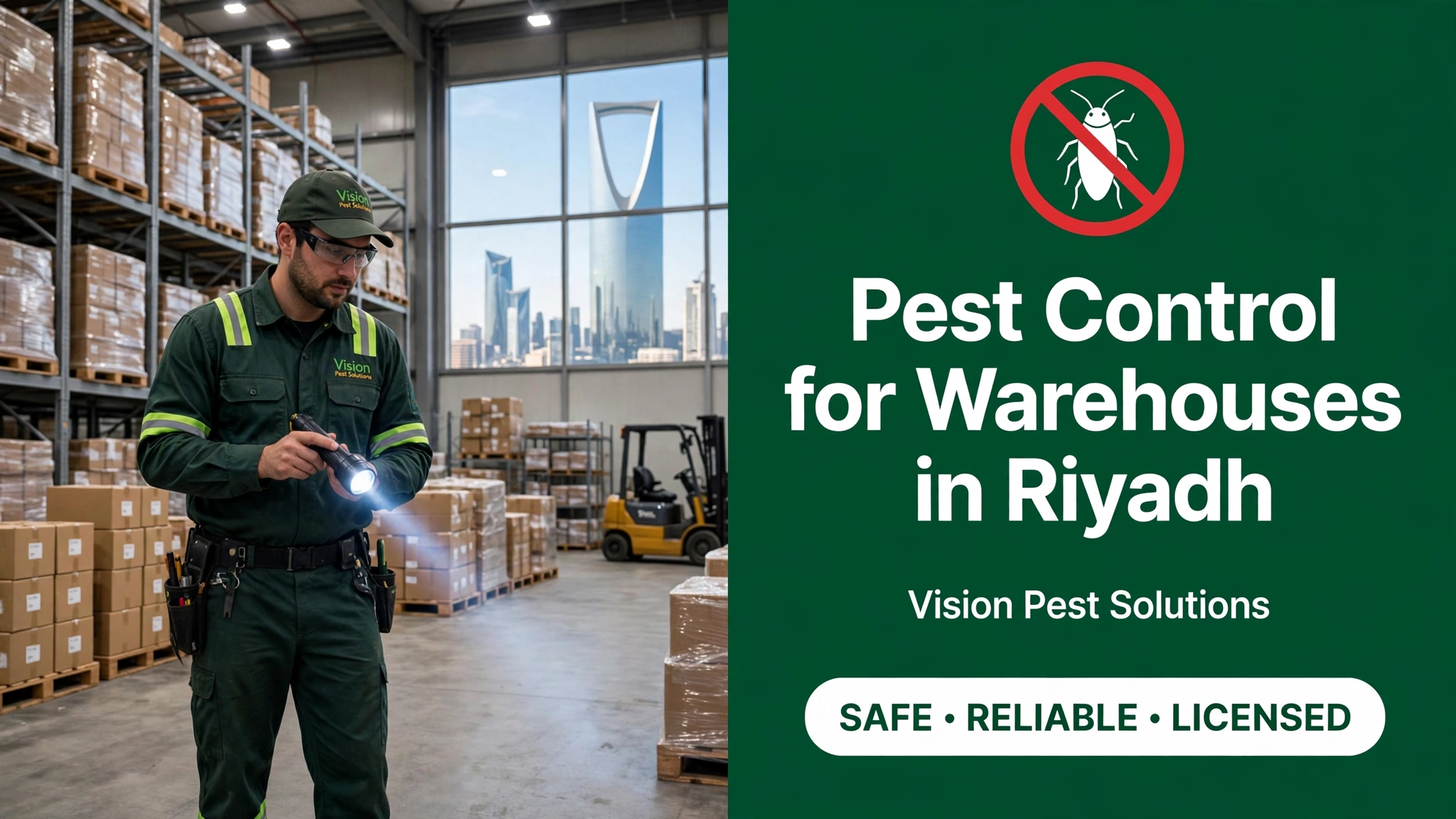
A warehouse problem is rarely found when it starts. It is found when a customer opens a pallet and finds beetles in the flour, when a forklift driver spots droppings on a rack, or when termites have already eaten through the wooden pallets under a full load. By then the damage is not one box — it is a whole batch, a rejected delivery, or a contract lost to a client who will not accept infested stock.
Warehouses in Riyadh are especially exposed. Large floor areas, high racking, warm temperatures all year, goods arriving from many suppliers, and doors that open all day for loading and unloading give pests constant chances to get in and stay hidden. This guide explains which pests warehouses face, how professional pest control protects stock without stopping work, and what a regular service looks like for a storage site.
Why warehouses attract pests
A warehouse offers pests the same things a home does, on a much bigger scale — and with far more places to hide.
- Food and stock everywhere. Dry goods, grains, spices, pet food, paper and cardboard packaging, and food products in storage are all food for stored-product pests and rodents.
- Wood and cardboard. Wooden pallets, crates and shelving are food for termites and shelter for cockroaches. Cardboard boxes are nesting material for rodents and hiding places for insects.
- Warmth and shelter. High racking, dark corners, mezzanines, false ceilings and the gaps behind stored goods stay warm and undisturbed for weeks.
- Constant movement. Every delivery can bring pests in — in pallets, in cardboard, in sacks of grain or in a container from another city. Every dispatch can carry them out to a customer.
- Doors open all day. Loading bays, roller doors and staff entrances stay open for hours, letting flying insects, cockroaches and rodents walk straight in.
A house can be treated in an hour. A warehouse needs a plan that covers the whole building, the stock inside it, and the flow of goods in and out.
The pests warehouses in Riyadh see most
Stored-product pests — small beetles, weevils and moths in flour, rice, grains, spices, dried fruit and animal feed — are the number one warehouse problem. They arrive inside the stock itself, breed quietly in sacks and boxes, and are usually found only when the damage is already done. One infested pallet can spread to the whole store if it is not isolated fast.
Termites attack wooden pallets, crates, shelving and the building itself. In a warehouse they are easy to miss: the damage is inside the wood, under a stack of boxes, and by the time a pallet collapses the colony has been there for months. See our guide to termite control in Riyadh for the signs to look for.
German cockroaches hide in warm, tight spaces — in the motors of forklifts and compressors, in electrical panels, in the gaps behind racking and in staff rooms and kitchens. They spread bacteria across stock and packaging, and a single sighting in a dispatch area can cost a client.
Rodents — rats and mice — gnaw packaging, contaminate food and feed with droppings, chew cables and damage stock. They follow the same routes as the goods: along walls, through loading bays and into stores. For the full detail on sealing a building against them, see our guide to rodent-proofing for restaurants and warehouses in Riyadh.
Flies and ants follow food and moisture into dispatch areas, staff rooms and any food stock. They are a smaller risk than the pests above, but they are often the first sign that hygiene or drainage in the building needs attention.
What professional warehouse pest control looks like
Pest control in a working warehouse cannot stop the forklifts. The treatment has to protect the stock, stay safe around staff, and fit around loading, dispatch and stocktaking.
At Vision Pest Solutions, warehouse pest control follows a 5-step process:
- Inspection and risk assessment — We inspect the whole site — racking, pallets, stores, loading bays, dispatch, offices, staff rooms, drains and the outside of the building — looking for pest activity, entry points, and the conditions that let pests breed: damaged stock, open sacks, standing water, gaps under doors and holes in walls. We also check what an auditor or a client would check. Our guide to what happens during a professional pest inspection in Riyadh explains what that inspection covers.
- Treatment plan — We set out a plan for the site’s real risks, not a generic spray. That means targeted treatment for the pest found, fumigation for a sealed store or container where the stock allows it, and gel baits in cracks and equipment voids for cockroaches. Sprays are used only where they are safe around stored goods, and never on open food or food-contact packaging. We agree the timing with you — usually outside loading hours or during a planned shutdown — so work is never stopped.
- Treatment — A trained technician carries out the treatment in protective equipment, using WHO-approved products applied exactly where the pests are. For a serious stored-product infestation, fumigation services in Riyadh can treat a sealed store or container so the gas reaches every part of the stock. We record what was used, where, and in what quantity — the written record an auditor asks for.
- Monitoring — We place monitors and traps across the warehouse — along walls, near loading bays, in stores and around racking — check them on each visit, and report what we found. A monitor that catches a few beetles early is a small job; the same beetles found by a customer are a rejected delivery.
- Regular visits and reporting — A monthly visit as a minimum, more often for food, grain or feed stores, catches a new problem while it is still small. The report after each visit is your evidence of a working pest control programme — for clients, for auditors, and for your own stock records.
Protecting stock: what warehouse staff should do
The technician’s visit is only half the job. Daily habits decide whether pests come back:
- Check deliveries before they go into the store — reject pallets or sacks that are damaged, damp or show pest signs, and isolate any suspect stock at once
- Store goods off the floor on pallets or racking, away from walls, so the floor can be cleaned and inspected underneath
- Rotate stock — first in, first out — so no pallet sits untouched for months while pests breed inside it
- Keep the warehouse clean and dry: sweep floors daily, clear spillages at once, keep drains clean and fix leaks fast
- Seal gaps around doors, windows, pipes and loading bays, and keep doors closed between deliveries
- Throw away damaged packaging and old cardboard at once — it is nesting material and hiding space
- Report the first sighting immediately — one beetle in a sack seen early is a small job; the same sighting ignored for a month is a whole store
When to call a professional
Call Vision Pest Solutions if:
- You have found beetles, weevils or moths in stored goods, or webbing and frass in sacks and boxes
- A pallet has collapsed or shows termite damage, or you have found mud tubes on walls or wood
- You have seen cockroaches or rodent droppings in the store, dispatch area or staff rooms
- A client or auditor has asked for proof of a pest control programme
- You are opening a new warehouse, or taking on food, grain or feed storage, and need a contract before the first delivery
- You run several sites and need the same service and the same report format across all of them
Call Vision Pest Solutions in Riyadh: 0593839745 or +966 500710106, or email info@vision-pest.com.
We provide professional pest control, disinfection and fumigation services in Riyadh, with WHO-approved products and KSA-registered, ISO-compliant processes.
Related guides in this series: Rodent-Proofing for Restaurants and Warehouses in Riyadh shows how businesses seal buildings against rats and mice; Fumigation Services in Riyadh explains sealed gas treatment for termites and stored-product pests; Termite Control in Riyadh covers the signs of termites and professional treatment; Cockroach Control in Riyadh explains the signs of cockroaches and how to stop them; What Happens During a Professional Pest Inspection in Riyadh? A Complete IPM Guide shows what an inspection covers and what the report should say; and Pest Control for Restaurants in Riyadh: Food-Safe Treatment, Inspections and Prevention covers the same food-safe approach for restaurant kitchens.
FAQ
Is pest control safe around stored food and goods?
Yes, when it is done properly. We use targeted treatments and, where the stock allows it, sealed fumigation — never a general spray over open food or packaging. We agree the method and the timing with you before any treatment.
How often should a warehouse have pest control visits?
Most warehouses in Riyadh need a monthly visit as a minimum, and food, grain or feed stores often need a fortnightly visit. The right frequency depends on the size of the site, what is stored, and what the monitors show.
Will treatment stop loading and dispatch?
No. Treatments are planned around your working hours, usually outside loading times or during a planned shutdown, and the areas treated are agreed in advance so dispatch is not interrupted.
What does an auditor or client ask for?
A current pest control contract and written reports from each visit, showing what was treated, what was found in the monitors, and what was done about it. We provide both after every visit, so the file is always ready.
Do you cover more than one warehouse?
Yes. We work with single warehouses and multi-site operators across Riyadh, including food, grain, feed, retail and general storage, with one report format per site.
What should we do with infested stock?
Isolate it at once, do not move it through the warehouse, and call us before it is dispatched or returned. Moving infested stock is the fastest way to spread the problem to the whole store.