
Most pest treatments fail for the same reason: they start before anyone has looked properly. A spray on the ants you can see does nothing about the nest in the wall. A trap in the wrong corner catches nothing. A professional pest inspection fixes that — it finds where the pests are, why they are there, and what will actually stop them coming back.
This guide explains what happens during a professional pest inspection in Riyadh, what IPM (Integrated Pest Management) means in practice, what the written report covers, and when an inspection is worth booking for your home, restaurant, warehouse or hotel.
What is a pest inspection — and what is IPM?
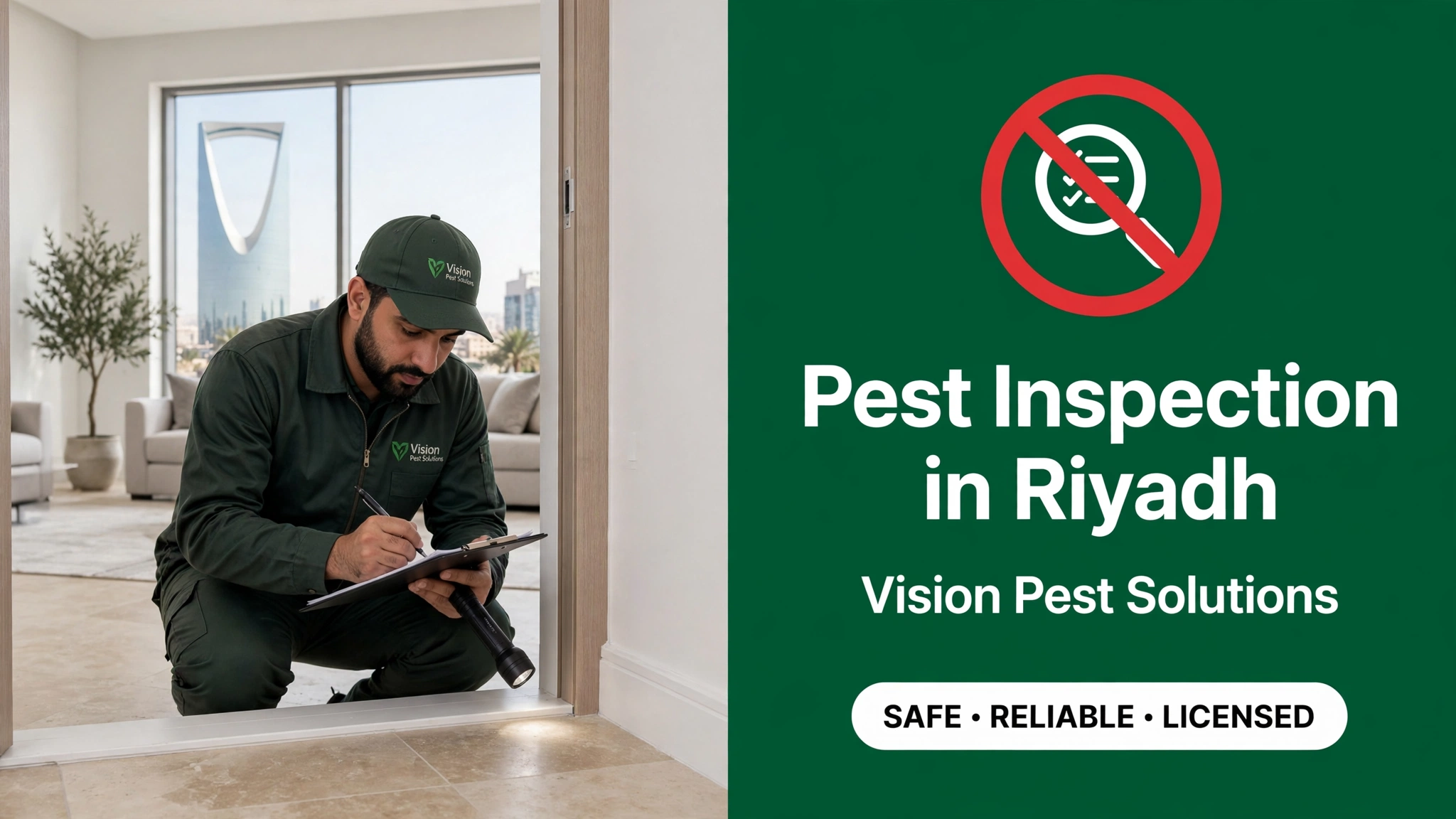
A pest inspection is a structured check of a building by a trained technician. It is not a spray visit. The technician looks, measures, photographs and records — and only then recommends a treatment.
IPM — Integrated Pest Management — is the method behind a good inspection. Instead of spraying first and asking questions later, IPM works in order:
- Inspect — find the pest, the entry points and the conditions that attract it
- Identify — name the exact pest, because ants, termites and cockroaches need different treatments
- Prevent — seal entry points, remove food and water, and fix the conditions that brought the pest in
- Treat — use the smallest effective treatment, targeted at the pest and the nest
- Monitor — check again on a schedule, so a new problem is caught early
In Riyadh, where warm weather keeps pests active all year round, that order matters. A building that is only sprayed will need spraying again. A building that is inspected, sealed and monitored stays clear for longer.
What the inspector checks, room by room
A full inspection usually takes 30 to 60 minutes for a villa or apartment, and longer for a restaurant, warehouse or hotel. The technician will check:
Kitchen and food areas
Skirting, cupboards, sinks, drains, bins and food stores. This is where cockroaches, ants and stored-product pests are found first — in the warmth, the moisture and the food.
Bathrooms and wet areas
Leaking taps, AC condensation, floor drains and damp tiles. Standing water and damp attract cockroaches and ants, and hide their routes into the building.
Bedrooms and living areas
Mattresses, bed frames, skirting and wardrobes for bed bugs; wooden doors, window frames and skirting for termites. The technician taps and probes wood, and looks for the fine dust and mud tubes termites leave behind.
Stores, basements and plant rooms
Pallets, cardboard, stored packaging, false ceilings and warm plant rooms — the shelter rodents and cockroaches use, and the places a quick spray never reaches.
Outside the building
Doors, windows, vents, drains, pipes, cracks in walls, the bin area, gardens and the ground around the building. Most pests come in from outside, so the outside check is as important as the inside one.
The technician carries a flashlight, a moisture meter and, where needed, a probe for wood. You do not need to move heavy furniture yourself — say what you have seen, and where, and the technician will check those places first.
The signs an inspector looks for
You may have seen one ant trail or one cockroach. The inspector is looking for the pattern behind it:
- Droppings and smear marks — size, shape and location say which pest it is and how long it has been there
- Gnaw marks and damaged packaging — the first sign of rodents in a store or kitchen
- Mud tubes, hollow wood and fine dust — the signs of termites, often found before any termite is seen
- Nests, egg cases and shed skins — cockroach egg cases behind appliances, ant nests near skirting, wasp nests under eaves
- Entry points — gaps around pipes and cables, vents without mesh, doors that do not close flush, dry floor drains
- Food, water and shelter — open sacks, spilled grain, leaking taps, AC condensation, pallets stacked against a wall
A good inspection also rules things out. If there is no sign of termites, the report says so — and you do not pay for a termite treatment you do not need.
What the written report covers
After the inspection you should receive a written report. At Vision Pest Solutions the report covers:
- What was found — the pest, where it was found, and how serious the problem is
- Where it is coming from — entry points, food and water sources, and the conditions that attract it
- What treatment is recommended — the method, the products, and how many visits it will take
- What proofing is needed — sealing, storage changes and waste routines, so the pest does not return
- What it will cost — a clear quote, before any treatment starts
- What happens next — the visit schedule and the follow-up checks
Keep the report. For a restaurant, warehouse or hotel it is the record an auditor, a client or a municipality inspector will ask for — and it is the proof that the building is being managed, not just sprayed when someone complains.
What happens after the inspection
An inspection does not commit you to a treatment. What usually follows, if you go ahead, is:
1. Treatment plan
The plan is specific to the building and the pest found. A cockroach problem in a restaurant kitchen gets a different plan from a termite problem in a villa, or a rodent problem in a warehouse.
2. Treatment
Targeted treatment — gel bait, residual spray, traps or fumigation — aimed at the pest and the nest, not a blanket spray of the whole building. See our guides on cockroach control, termite control, ant control and fumigation services in Riyadh for what each treatment involves.
3. Proofing
Sealing gaps, fitting door seals and mesh, changing storage and waste routines. Proofing is what stops the next infestation, and it is covered in our rodent-proofing guide for restaurants and warehouses.
4. Follow-up and monitoring
A return visit to check the treatment worked, and a regular schedule for businesses — monthly or quarterly, with a written report after each visit. A single treatment rarely ends a serious infestation without a check.
Pest inspection for restaurants, warehouses and hotels in Riyadh
For a food business, an inspection is not optional — it is part of staying open. A restaurant, warehouse, hotel or food factory in Riyadh needs proofing and a written record because a contract, a client audit or a municipality inspection can ask for it at any time.
For businesses we recommend:
- A full inspection before opening a new site, and before the warm season each year
- A written report after every visit, kept on file for audits and inspections
- A regular visit schedule — monthly or quarterly — with monitoring points checked each time
- Staff training on what droppings, gnaw marks and damaged packaging look like, and who to tell the same day
A building with sealed entry points, tidy storage, a clean bin area and a written monitoring record passes those checks far more easily — and it is cheaper to inspect and proof a building than to lose stock, fail an inspection or close a kitchen for treatment.
How to prepare for an inspection
You do not need to clean the whole building, and you do not need to empty cupboards. A little preparation helps the technician see more:
- Clear access to skirting, sinks, drains and the back of cupboards where you have seen pests
- Note down what you have seen, where and when — a trail, a dropping, a smell, a noise at night
- Keep pets in one room during the visit, and tell the technician about children, allergies or food areas
- Have the building’s history ready if you know it: previous treatments, previous infestations, recent leaks or building work
The technician will tell you if anything needs to be moved or opened. Do not spray before the inspection — a spray scatters the pests and hides the signs the inspector needs to read.
How often should a building be inspected?
It depends on the building and the risk:
- Homes: once a year, or straight away if you see signs of termites, bed bugs or rodents
- Restaurants and food businesses: every month or every quarter, as part of a contract
- Warehouses and stores: every quarter, and before the warm season
- Hotels and apartments: every quarter, with a check after any guest report
- After treatment: a follow-up inspection, to confirm the treatment worked
A regular inspection costs far less than an infestation discovered late — especially termites, which can damage wood for months before anyone sees them.
When to call a professional
Call Vision Pest Solutions if:
- You have seen droppings, gnaw marks, mud tubes or damaged packaging, and you do not know what pest it is
- Pests keep returning after cleaning or spraying
- You run a restaurant, warehouse, hotel or food factory in Riyadh and need a written inspection record
- You are buying, renting or opening a new property and want to know what you are taking on
- You are not sure whether you need treatment at all — an inspection will tell you, and we will say so honestly if no treatment is needed
Call Vision Pest Solutions in Riyadh: 0593839745 or +966 500710106, or email info@vision-pest.com.
We provide professional pest control, disinfection, and fumigation services in Riyadh, with WHO-approved products and KSA-registered, ISO-compliant processes, for government, industry, and private clients.
Related guides in this series: Cockroach Control in Riyadh explains the signs of cockroaches and professional treatment; Termite Control in Riyadh covers the signs of termites and how they are treated; Ant Control in Riyadh shows how ants enter buildings and how to stop them; Rodent-Proofing for Restaurants and Warehouses in Riyadh shows how businesses seal buildings against rats and mice; and Fumigation Services in Riyadh explains when fumigation is the right treatment.
FAQ
How long does a pest inspection take?
Usually 30 to 60 minutes for a villa or apartment, and longer for a restaurant, warehouse or hotel. The written report follows the visit.
Do I need to leave during the inspection?
No. An inspection is a check, not a treatment — nobody sprays during it, and you can stay in the building and walk round with the technician.
Will the technician spray on the same visit?
Not usually. The inspection comes first, then the plan and the quote. If you approve the plan, treatment is booked as a separate visit, so it is done properly and safely.
How much does a pest inspection cost in Riyadh?
It depends on the size and type of the building. Call us for a quote after a short call about the property — and if you go ahead with treatment, the inspection is part of the plan.
What if the inspection finds nothing?
Then the report says so, and that is a good result. You will still have the entry points and the prevention advice, and a baseline for the next check — so a future problem is caught early.