
Rats and mice do not need an invitation to enter a restaurant or a warehouse in Riyadh — they need a gap the width of a pencil, a food source, and somewhere warm to hide. For a home, a rodent is a nuisance. For a restaurant or warehouse, it is a failed inspection, spoiled stock, damaged packaging, and customers who do not come back.
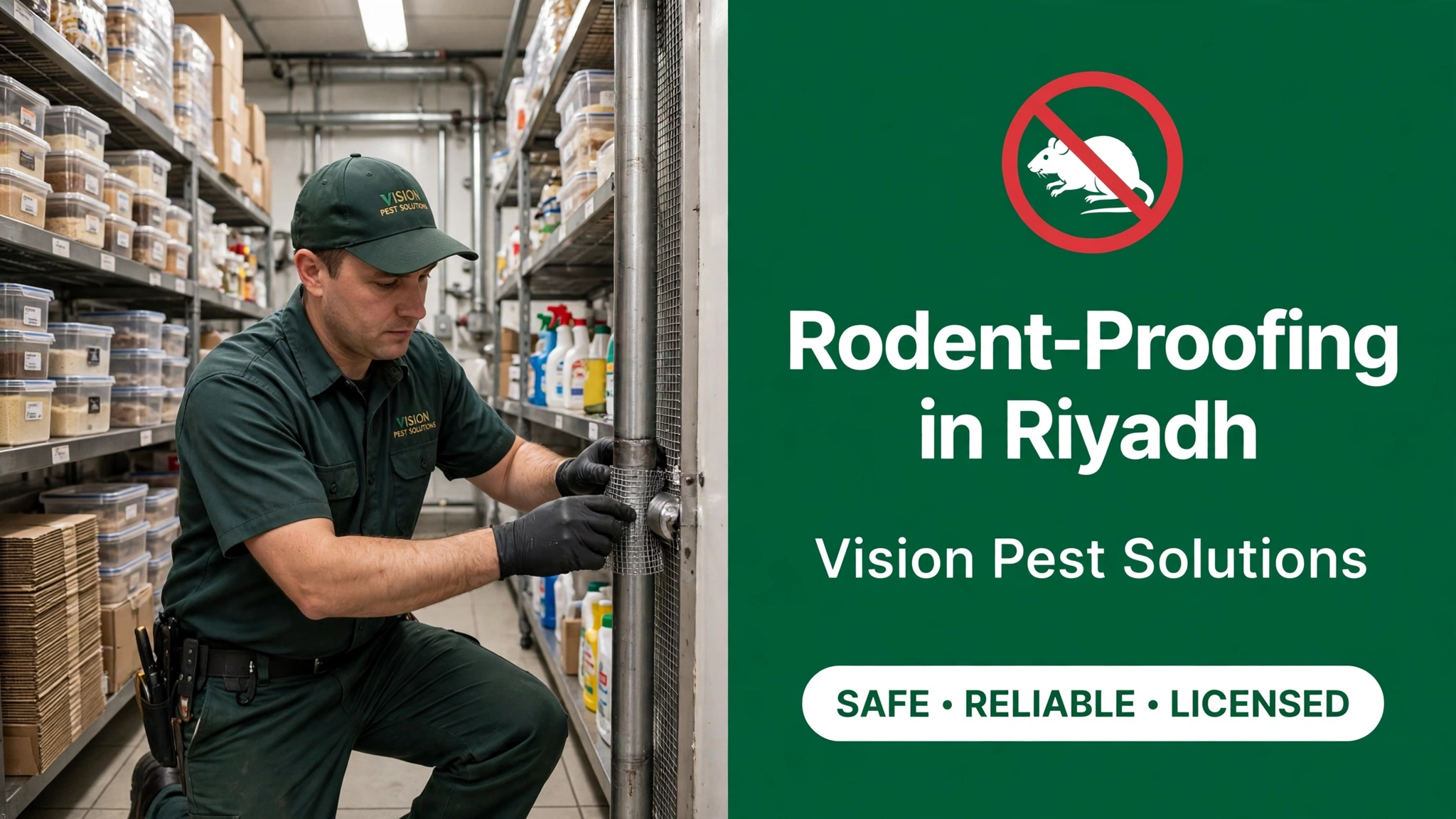
This guide explains rodent-proofing for restaurants and warehouses in Riyadh: how to seal a building properly, store food and stock so rodents cannot reach it, manage waste, and set up inspections that catch a problem before it becomes an infestation. Proofing is not a one-time spray. It is the building, the routines, and the monitoring working together.
Why restaurants and warehouses are at higher risk
Restaurants and warehouses give rodents everything they need in one place:
- Food, all day: kitchens, dry stores, open sacks, spilled grain and flour, and food waste in bins
- Water: leaking taps, AC condensation, floor drains, and mop buckets left full overnight
- Shelter: pallets, cardboard, stored packaging, false ceilings, and warm plant rooms
- Entry points: delivery doors held open, gaps around pipes and cables, vents without mesh, and roller shutters that do not close flush
In Riyadh, the warm climate keeps rodents active all year round. A warehouse with pallets stacked against a wall, or a restaurant with a back door propped open during deliveries, is an open route in.
Step 1: seal the building
Sealing is the highest-value step, and it is the one most often skipped. A mouse can pass through a gap of about 6 mm; a rat needs about 20 mm. Walk the building with this checklist:
- Seal gaps around pipes, cables, and drains where they pass through walls and floors, with cement or metal mesh — not foam alone, which rodents chew through
- Fit brush strips or rubber seals to external doors, including delivery doors and roller shutters, so no light shows underneath when closed
- Cover vents, air bricks, and openings with fine metal mesh, and check the mesh has not rusted or been knocked loose
- Repair broken tiles, cracked walls, and gaps under skirting in stores and kitchens
- Keep delivery doors closed between deliveries — do not prop them open
Sealing does not mean sealing the building shut. It means closing the routes rodents actually use, and keeping the doors and shutters that must open working properly.
Step 2: store food and stock so rodents cannot reach it
Rodents follow food. Storage that is tidy and off the floor removes most of the reason to stay:
- Store dry food, grain, flour, and pet food in sealed, hard containers with lids — not open sacks
- Keep all stock at least 15 cm off the floor and 30 cm from walls, so you can see, clean, and inspect behind it
- Rotate stock first-in, first-out, and check the oldest stock first — damaged sacks and spilled food are the first sign of activity
- Do not store food, cardboard, or packaging in the same area as waste
- In warehouses, keep pallets away from walls, break down empty cardboard the same day, and do not let damaged stock pile up in a corner
If staff cannot see behind a stack, neither can an inspector — and rodents know it.
Step 3: manage waste and water
Waste is the second food source, and the one that draws rodents from outside:
- Use bins with tight-fitting lids, inside and outside, and empty them daily — never leave full bins overnight
- Keep the bin area clean, hosed down, and away from the delivery door; spilled food under a bin is a feeding station
- Fix leaking taps and pipes the same day, and do not leave mop buckets full or floor drains dry — dry drains are an entry route
- Clear standing water around AC units and in plant rooms
A clean bin area will not stop a determined rat on its own, but a dirty one guarantees repeat visits.
Step 4: inspect, monitor, and act early
Proofing only works if someone checks it. For a restaurant or warehouse, that means a routine, not a reaction:
- Weekly self-check: doors and seals, bin area, dry store, and the floor behind pallets — look for droppings, gnaw marks, footprints in dust, and damaged packaging
- Monitoring points: tamper-proof bait stations and traps placed by a professional along walls and near entry points, checked on a schedule — never place loose poison where food is stored or prepared
- Written record: date, what was found, and what was fixed, so a pattern shows up before an infestation does
- Staff reporting: everyone who works in the building should know what droppings and gnaw marks look like, and who to tell the same day
If you find droppings, gnawed packaging, or a dead rodent, do not just clean it up and move on. That is the sign to call for a professional inspection — the colony is already inside, or close to it.
What professional rodent-proofing looks like
At Vision Pest Solutions, rodent-proofing for a restaurant or warehouse in Riyadh follows four steps:
- Inspection — We inspect the building inside and out — doors, shutters, pipes, drains, vents, stores, pallets, and the bin area. We identify entry points, food and water sources, and signs of activity, and we check the areas an inspection by the municipality or a client would check.
- Proofing plan — We set out what to seal, what to change in storage and waste routines, and where monitoring points should go. The plan is specific to the building — a restaurant kitchen needs different proofing from a warehouse with high racking.
- Treatment and sealing — Where rodents are already active, we treat first, then seal — sealing a building with rodents still inside traps them in. We use safe, approved products, applied by trained technicians, with care for food areas, children, and pets.
- Contract and follow-up — For restaurants, warehouses, hotels, and food factories, we provide a regular visit schedule with a written report after each visit: what was checked, what was found, and what was fixed. Rodent-proofing is not a single visit; it is sealing, routines, and monitoring together.
Related guide in this series: Rodent Control in Riyadh — signs, treatment, and prevention for homes and businesses, and Cockroach Control in Riyadh for the other common pest in Riyadh kitchens and stores.
Rodent-proofing and inspections
Many restaurants and warehouses in Riyadh need proofing not because they have a visible infestation, but because a contract, a client audit, or a municipality inspection requires it. A building with sealed entry points, tidy storage, a clean bin area, and a written monitoring record passes those checks far more easily — and it is cheaper to proof a building than to lose stock, fail an inspection, or close a kitchen for treatment.
When to call a professional
Call Vision Pest Solutions if:
- You find droppings, gnaw marks, or damaged packaging in a store or kitchen
- You run a restaurant, warehouse, hotel, or food factory in Riyadh
- You need a proofing plan before an inspection, an audit, or a new contract
- Rodents keep returning after cleaning and sealing
Call Vision Pest Solutions in Riyadh: 0593839745 or +966 500710106, or email info@vision-pest.com.
We provide professional pest control, disinfection, and fumigation services in Riyadh, with WHO-approved products and KSA-registered, ISO-compliant processes, for government, industry, and private clients.
FAQ
How much does rodent-proofing cost in Riyadh?
It depends on the size of the building, the number of entry points, and whether it is a one-time proofing visit or a regular contract. Call us for a quote after a free inspection.
Is rodent-proofing safe around food?
Yes, when done by a trained technician. We use tamper-proof stations and approved products, placed away from food preparation and storage, and we explain any precautions before we start.
How often should a restaurant or warehouse be inspected?
Monthly visits are the usual minimum for food businesses; warehouses with high stock turnover may need more frequent checks. We set the schedule after the first inspection.
Do I need to close the business during treatment?
In most cases, no. We plan treatment around your working hours and tell you in advance if any area needs to be empty for a short time.