
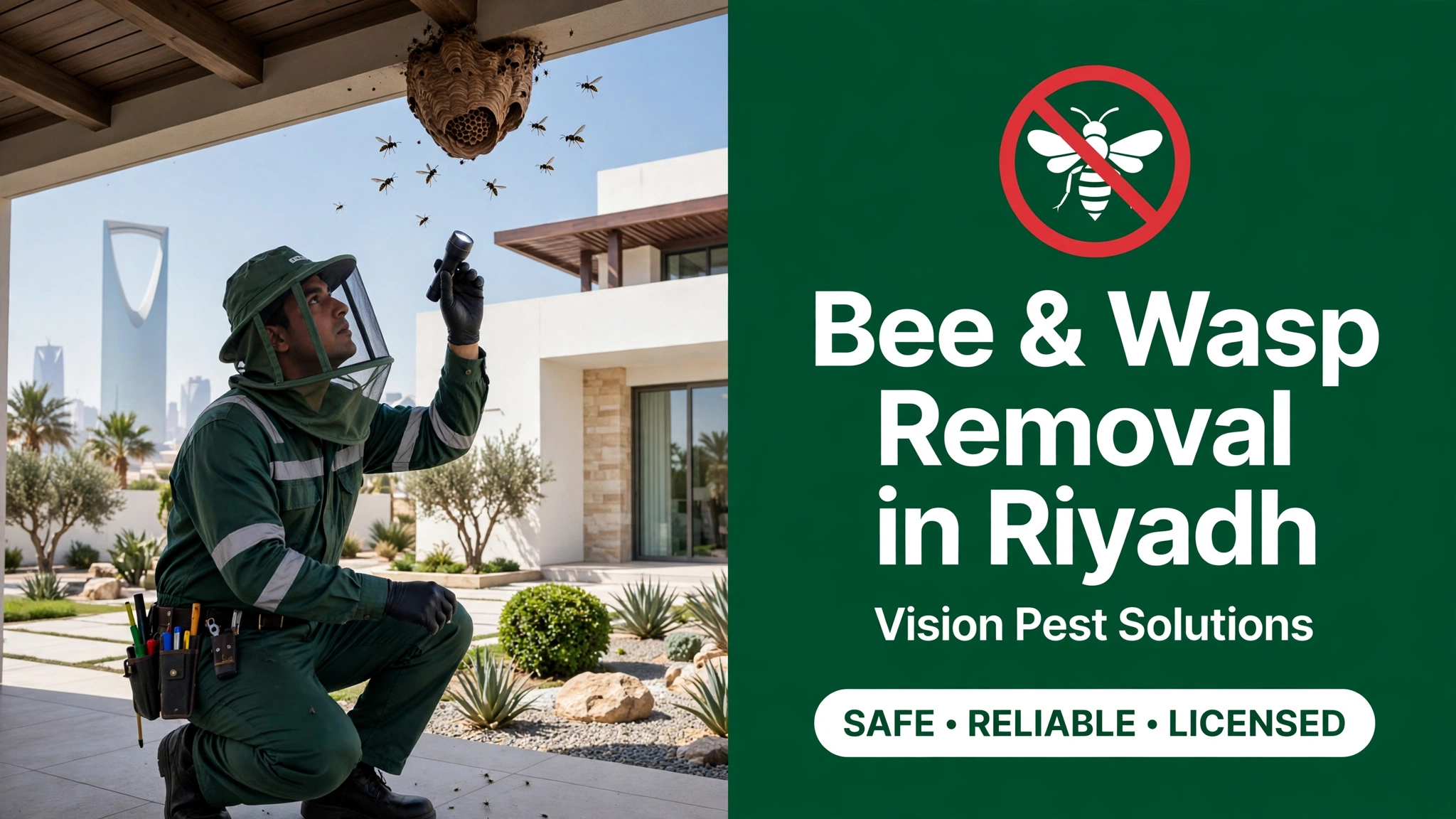
A bee or wasp nest on a villa wall, under a roof edge or in a warehouse shutter is not a problem to solve with a spray can and a ladder. Wasps defend their nest aggressively, and a disturbed colony can sting many times in seconds. In Riyadh, where outdoor living, gardens, restaurants with terraces and warehouses with open shutters are common, nests appear through most of the year — and the safe answer is almost always a professional removal.
This guide explains how to tell bees from wasps, what to do (and not do) when you find a nest, and what professional bee and wasp removal in Riyadh actually involves.
Bees or wasps — why it matters
Bees and wasps look similar from a distance, but they behave very differently:
- Honey bees are fuzzy, golden-brown, and usually focused on flowers. They sting once, and only when threatened. A honey bee swarm resting on a wall or tree is often just passing through — it may move on within a day or two.
- Wasps are smooth, bright yellow and black, with a narrow waist. They are attracted to food, drink, bins and meat, and they can sting repeatedly. Wasps are the ones that ruin an outdoor meal and defend a nest aggressively.
- Solitary bees nest alone in small holes in walls or soil and are rarely a problem.
If you are not sure which one it is, do not get close to find out. Take a photo from a safe distance and let a professional identify it — the treatment is different, and honey bees are relocated where possible rather than destroyed.
Signs you have a nest
Look for these signs, especially in spring and summer and after warm evenings:
- Bees or wasps flying in and out of the same hole, crack, vent or gap, again and again
- A steady stream of insects around a roof edge, wall cavity, roller shutter box, AC unit or garden wall
- A visible grey, papery nest under eaves, in a tree, or in a store room corner
- Wasps gathering around bins, food waste, sugary drinks or pet food outdoors
- A loud buzzing from inside a wall or ceiling — a nest inside the structure
A few bees on flowers is normal. The same insects returning to one hole, all day, means a nest.
What NOT to do
Most stings happen when someone tries to deal with a nest themselves:
- Do not spray a nest with shop insecticide. It rarely reaches the colony, it angers the wasps, and it can scatter them into the building.
- Do not block the entrance hole. Trapped wasps find another way out — often inside the house.
- Do not poke, knock down or hose a nest, and do not stand on a ladder to reach one. A fall plus stings is how a small job becomes an emergency.
- Do not try to remove a nest at night without protective equipment. Wasps are less active at night but still sting, and you cannot see where they are coming from.
- Keep children and pets indoors, close nearby windows, and keep the area clear until a professional arrives.
If someone is stung many times, or has trouble breathing, swelling of the face or lips, or dizziness after a sting, call emergency services immediately — that is an allergic reaction, not a normal sting.
What professional removal looks like
At Vision Pest Solutions, bee and wasp removal follows a 4-step process:
- Inspection and identification — We inspect the property — roof edges, wall cavities, shutters, vents, AC units, gardens and store rooms — and identify whether it is bees, wasps or another insect, where the nest is, and how large it is. For honey bees, we assess whether the colony can be relocated.
- Treatment plan — We set out the safest method for the species and the location: relocation for honey bees where possible, or a targeted treatment for a wasp nest. We explain the timing — most treatments are done in the early morning or evening, when the colony is inside the nest — and any precautions for the household or business.
- Removal — A trained technician in protective equipment treats or removes the nest, using approved products applied directly to the nest — not sprayed across the whole area. The nest is removed where it can be reached safely, and the entry point is noted for sealing.
- Prevention and follow-up — We advise on sealing the entry point, removing what attracted the insects, and checking the area again. For restaurants, warehouses and hotels, we provide a written report and a regular visit schedule, so a new nest is caught early.
Bee and wasp removal for businesses in Riyadh
Restaurants with outdoor seating, cafes, hotels, schools, warehouses and food factories have a higher risk — and a higher cost if a customer or an employee is stung.
For businesses, we recommend:
- A full inspection of roof edges, shutters, vents and bin areas before the warm season
- Sealing gaps and fitting mesh on vents where nests keep appearing
- Covered bins, emptied daily, and food waste kept away from seating areas
- Monthly or quarterly visits during the active season, with a written report after each visit
This is part of our pest control service for government, industry and private clients across Riyadh.
How to prevent nests at home
- Seal gaps around roof edges, vents, pipes and roller shutter boxes
- Fit fine mesh on vents and openings that cannot be sealed
- Keep bins covered and emptied daily, and clean up sugary spills outdoors
- Do not leave pet food, fruit or sugary drinks outside
- Check garden walls, trees and store rooms early in the season — a small nest is far easier to remove than a large one
- Trim trees and shrubs away from the roof and walls
Prevention helps, but if a nest is already established inside a wall or roof, prevention alone will not remove it.
When to call a professional
Call Vision Pest Solutions if:
- You find a nest on the building, in a wall, roof, shutter or AC unit
- Wasps are entering the house or gathering around food and bins
- A swarm has settled on a wall, tree or vehicle and has not moved on
- You run a restaurant, school, hotel or warehouse in Riyadh and need the area safe
- Anyone in the household is allergic to stings
Call Vision Pest Solutions in Riyadh: 0593839745 or +966 500710106, or email info@vision-pest.com.
We provide professional pest control, disinfection and fumigation services in Riyadh, with WHO-approved products and KSA-registered, ISO-compliant processes.
Related guides in this series: Ant Control in Riyadh explains how ants enter homes and how to stop them; Termite Control in Riyadh covers the signs of termites and professional treatment; Cockroach Control in Riyadh is the guide for the most common pest in Riyadh kitchens; and Rodent-Proofing for Restaurants and Warehouses in Riyadh shows how businesses seal buildings against rats and mice.
FAQ
How long does bee or wasp removal take?
A home inspection usually takes 30–60 minutes. Treatment itself is usually quick, but we may need a follow-up visit to confirm the nest is fully inactive and the entry point is sealed.
Is the treatment safe for children and pets?
Yes, when applied by a trained technician. We use approved products, applied directly to the nest, and explain any precautions — such as keeping an area clear for a few hours — before we start.
Can honey bees be relocated instead of removed?
Where possible, yes. Honey bees are valuable pollinators, so we assess each colony for relocation first. Wasps, which are aggressive and return to the same site, are treated instead.
How much does bee and wasp removal cost in Riyadh?
It depends on the size and location of the nest — a nest under eaves costs less to reach than one inside a wall cavity. Call us for a quote after a free inspection.
Do I need to leave the house?
In most cases, no. We ask you to keep the area around the nest clear and windows nearby closed during the treatment, and we tell you in advance if any room needs to be empty for a short time.